



Three takeaways from the world’s largest edtech event
By Craig Nicholson, Chief AI Officer
15 May 2026
Following his recent trip to the world’s largest event on the future of learning and education technology in California, Cambridge University Press & Assessment’s Chief AI Officer Craig Nicholson reflects on a surprising mood shift from the birthplace of AI. Beyond the hype, conversations about AI in education are starting to sound more grown up, he argues. Read his key takeaways and why it matters for Cambridge.
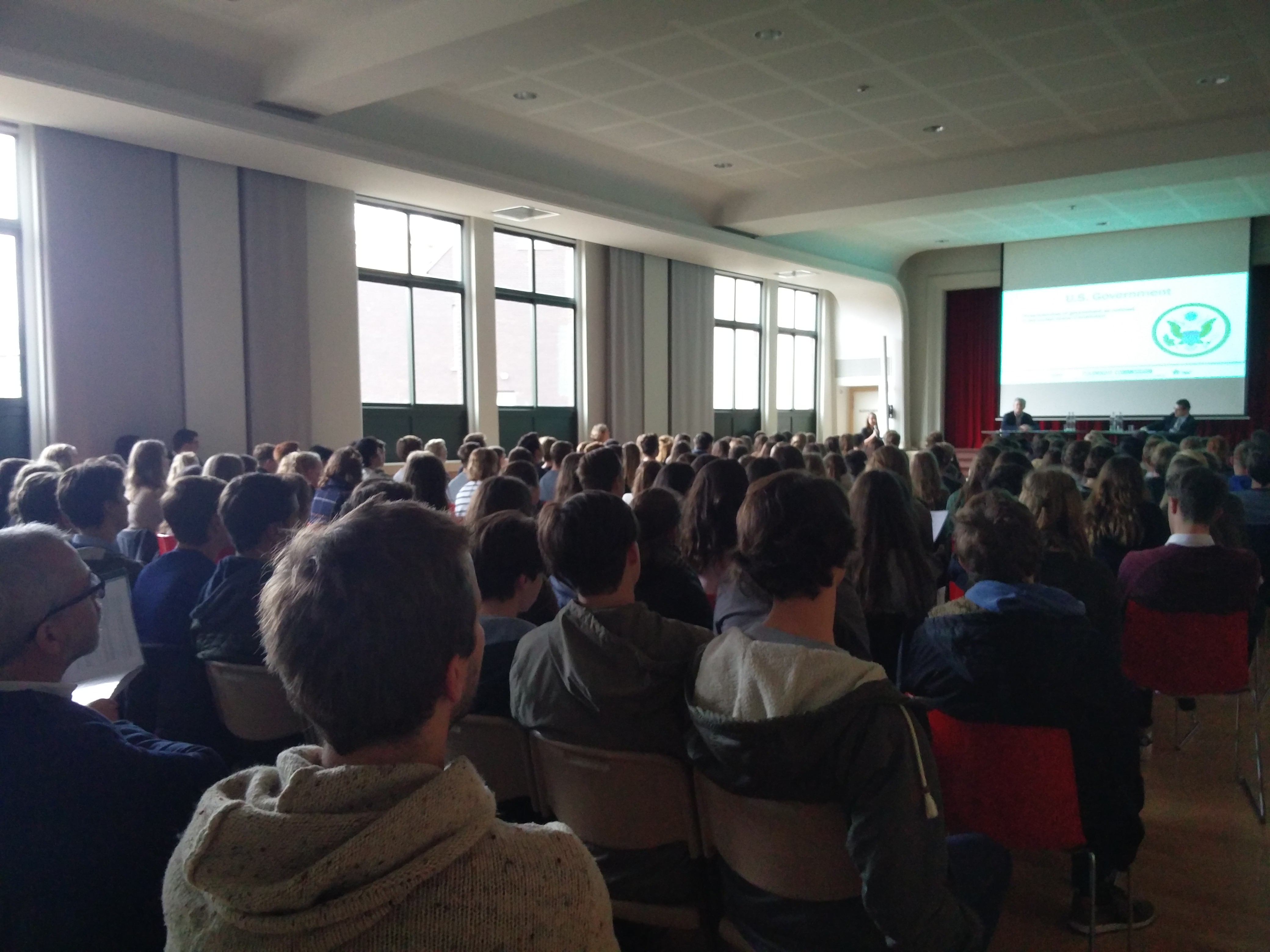
“The ASU+GSV Summit in San Diego brings together educators, policy-makers, researchers, education technology providers, investors and major technology companies including Google, Anthropic, Microsoft and Amazon to discuss what’s next for learning technology. With more than 7,000 delegates from 65 countries around the world, it’s been described as ‘the Davos of education‘.
“There were certainly lots of shiny new AI products that caught my eye —including Google’s new 3D meeting avatars, Project Beam, heralded as ‘the future of communication’.
“But one theme that kept on resurfacing was that progress with AI will come not from hype, but from careful design that improves eventual outcomes and earns trust from teachers, parents and learners alike.”
“That’s something we’ve already been prioritising here at Cambridge University Press & Assessment, as evidenced by partnerships with organisations like Educate Ventures Research, which focus on responsible AI innovation backed up by sound research.
“As the world collectively learns more about how the technology works and the research emerges and evolves, so the conversation about how we’re using and implementing AI within our wider society and communities is maturing too. Companies across the Atlantic and closer to home are in a cycle of testing, doing research, understanding and learning—and then applying and scaling these learnings in a continuous cycle.
“Big tech companies like Anthropic struck a measured tone in San Diego—focusing on ‘human-in-the-loop’ design, careful evaluation and more cautious progress—especially when working with young people; Google talked of creating scaffolded learning environments with strong guardrails in place.
“What struck me most was that the learnings around AI were leading to more grown-up conversations—and the mood music from California was surprisingly reassuring for those of us in the education sector who have long been calling for a more cautious and human-centred approach.”
Here are Craig’s three takeaways from the event and what this means for Cambridge:
1: Human value becomes even more important as AI capability rises
“Perhaps the strongest theme to emerge from this year’s ASU+GSV Summit was that human value within the AI process is the most important thing. In other words, it’s not about AI replacing educators, it’s about amplifying them.”
“What I heard loud and clear is that AI is not going to replace human motivation, human coaching, human trust or relational intelligence. Instead, it’s about helping teachers to do more of what only humans can do. That human-centred approach also reduces the risk of a gap opening up between what systems can do and what institutions, teachers and learners are ready to adopt safely and responsibly.”
2: AI works best with clear structure and guardrails in place
“From what I could glean, tech companies are starting to understand that AI is not something you can just push into the market and hope for the best. There’s growing understanding that it needs careful consideration to make sure it’s appropriate and suitable for what you’re trying to do with it.
“One recurring message from San Diego was that AI in education is most effective when it has sufficient guardrails in place and is deliberately bounded—designed to support specific learning objectives rather than operating as an unrestricted substitute for a teacher.”
“This is an area where Cambridge has been focusing a lot of our energy. Last year, we released a paper that defined six key principles for ethical AI in English language education. A human-centred approach to AI is central to our stance: acknowledging the essential role of the human in both language attainment and quality assessment. We’re also urging that more care should be taken to ensure AI is fair and inclusive and that security, privacy and consent are consistently prioritised.”
3: Trust is the foundation—and it has to be earned
“For AI to be used at scale in education, parents, teachers and learners all need confidence not only that AI is useful but that it is safe, fair and being used for the right purposes.”
“It was reassuring to see in California that these conversations are happening more widely and it’s being recognised by both the big tech providers and education solution providers as critical to ensuring the success of AI technology within the education sector.
“That points to a practical checklist: transparency about how systems work and what data they use, age-appropriate safeguards, explainability where it matters and independent assurance as well as clear articulation of outcomes.
“In other words, trust needs to be baked in right from the start of every new product design and in every conversation about AI in an education context.”
Why this matters for Cambridge
“From Cambridge University Press & Assessment’s perspective, the themes and conversations emerging in California align with how we are already thinking about innovation in learning: start with the human need, build technology that supports (not replaces) humans, and make trustworthiness non-negotiable.
“The biggest risks discussed in the conference halls of San Diego were not model failure, but poor design and implementation—cognitive offloading, emotional over-dependence, weak evaluation, lack of transparency, false trust and over-automation in areas where human judgement should remain central. In the education sector in particular, many speakers were clear that trust can be lost quickly if institutions move faster than their evidence base or governance allows.
“A recent joint study between Cambridge University Press & Assessment and Microsoft Research found that large language models (LLMs) like ChatGPT or Microsoft Copilot can be a useful tool for helping students clarify, explore and contextualise learning material. But the study concluded that traditional note-taking was more effective than ChatGPT for retaining knowledge.
“More research is still needed on the impact of generative AI on the fundamental processes of learning. We need to prioritise evidence of impact, designing structured experiences rather than ‘AI everywhere’ and we need to be transparent—both internally and externally—about the safeguards and governance that sit behind AI.
“What struck me most as I returned from California to Cambridge UK is that AI will continue to play a meaningful role in education—but the market seems to be converging on a more mature view of the role AI will play in future.
“The most productive conversations seem to be moving beyond novelty and towards disciplined implementation: structured use cases, human-centred design that improves learning precision, feedback and efficiency, and that has trust built into the foundations. If everyone keeps those priorities in view, AI can help educators and learners achieve more—without losing what matters most.”
Picture: Craig Nicholson, Chief AI Officer, at ASU+GSV, San Diego, April 2026
Source: Cambridge University
Categories: Leadership in AI


