



On Boat Race day in London, The Future Leadership Institute turned one of the world’s oldest university sporting rivalries into a laboratory for leadership. Olympic rowers, business leaders, academics and students gathered at London Rowing Club to explore what an eight-person boat can teach us about teamwork, competition, decision-making and high performance.
There are few sporting events where the worlds of education, tradition, leadership and competition come together as naturally as at the Oxford–Cambridge Boat Race.
Oxford and Cambridge are among the world’s most famous universities.
The Boat Race is one of Britain’s most enduring sporting traditions.
And inside every racing shell is a remarkably unforgiving experiment in leadership and teamwork.
Eight rowers.
One cox.
One boat.
One objective.
If one member of the crew decides to demonstrate individual brilliance at the expense of the others, the boat does not go faster.
It goes slower.
That paradox was at the heart of an unusual series of seminars organised by The Future Leadership Institute around the Oxford–Cambridge Boat Race.
The concept was called:
The Business of Rowing.
Taking the classroom to the Thames
Rather than organising another conventional leadership conference in a hotel or university lecture theatre, FLI took participants to the place where the principles being discussed could actually be observed.
On 3 April 2010, Boat Race day, FLI organised “The Business of Rowing 2” at the historic London Rowing Club in Putney.
At the time, the Institute temporarily carried the name The Wall Street Journal Europe Future Leadership Institute.
The idea and concept for The Business of Rowing were developed by Gert Van Mol.
The setting mattered.
London Rowing Club sits beside the Thames at Putney, close to the start of the Championship Course.
Participants did not discuss teamwork from a conference centre miles away from the action.
They were sitting inside a rowing club while some of the world’s most accomplished university rowers prepared to race outside.
Half students, half leaders
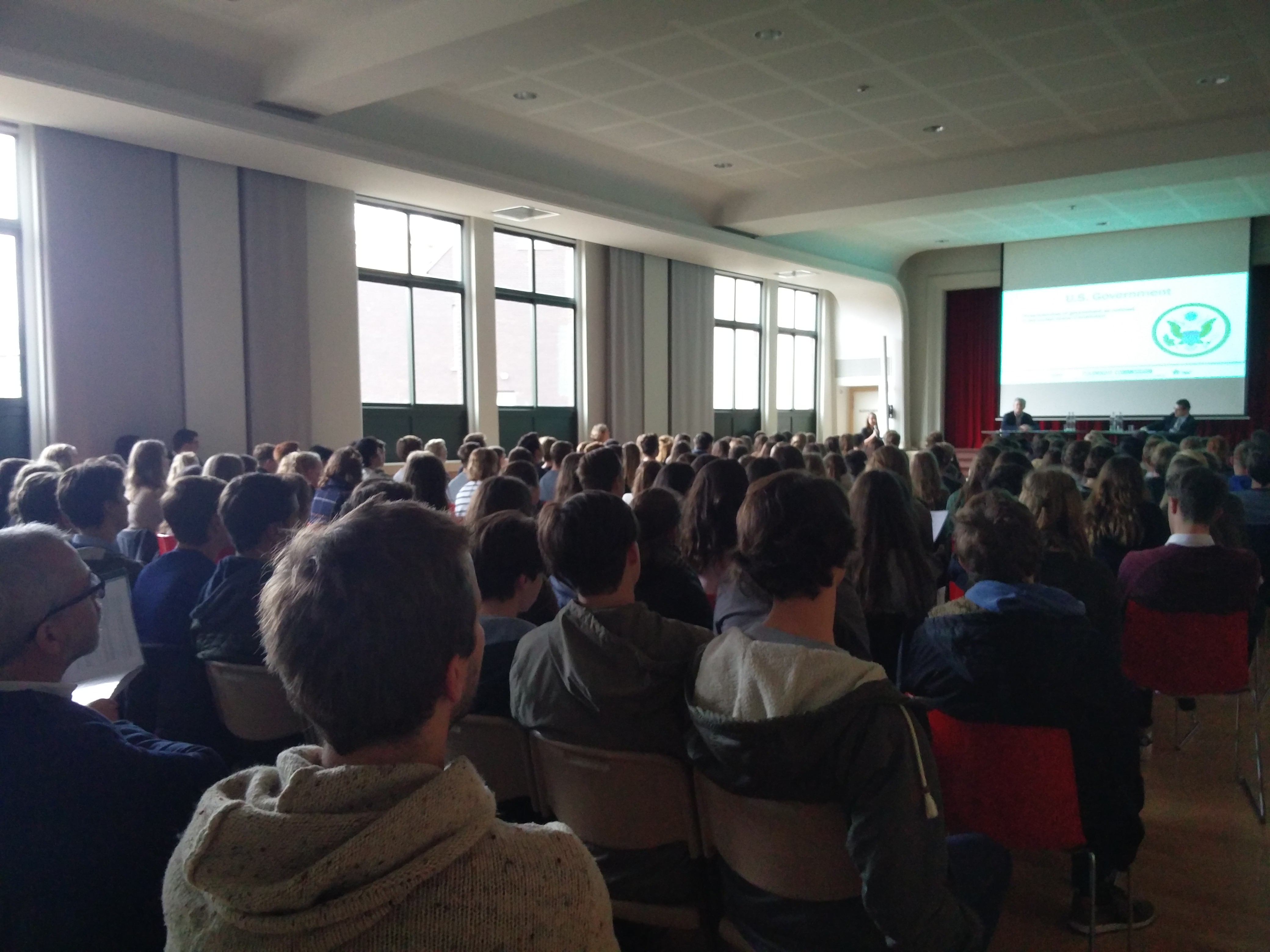
The composition of the audience was equally deliberate.
FLI described an audience of approximately 60 people, divided roughly equally between:
50% university students and 50% business and thought leaders.
That reflected the central philosophy of The Future Leadership Institute.
The Institute had been created as a platform for bridging university and industry.
Students should not only listen to professors.
Business leaders should not only talk to other business leaders.
Put both groups together, add people with extraordinary experience outside business, and allow them to question each other.
The atmosphere was explicitly intended to be informal.
Questions and discussion between speakers and participants were encouraged. The Future Leadership Institute
What can business learn from rowing?
Rowing provides an unusually powerful model for thinking about organisations.
An eight is not simply a collection of eight strong athletes.
The rowers have to produce power together.
Their movements must be synchronised.
Their timing must be precise.
They must trust one another.
They have to accept a common rhythm.
And while the athletes provide the physical power, another person — the cox — observes, communicates, motivates and makes tactical decisions.
That raises questions that apply far beyond sport.
How do you assemble a high-performance team?
Is a collection of exceptional individuals necessarily an exceptional team?
When should an individual sacrifice personal preferences for collective performance?
How much internal competition improves a team before it begins to destroy it?
How does a leader maintain performance under extreme pressure?
And perhaps most importantly:
What makes talented people work as one?
Those questions formed a natural bridge between rowing and business.
A Cambridge professor inside the boat
Among the speakers at the 2010 FLI seminar was Dr Mark de Rond of Cambridge Judge Business School.
De Rond had taken an unusually immersive approach to studying high-performance teams.
Rather than studying teamwork only from surveys and management literature, he embedded himself with the Cambridge University Boat Club for months.
His research became the basis for his book The Last Amateurs.
That made him particularly suited to the FLI concept.
The Boat Race offered something that organisations constantly seek but rarely obtain: a highly visible, measurable outcome produced by a small group of extremely talented individuals operating under enormous pressure.
Yet the strongest individual athletes do not automatically form the fastest crew.
That distinction between individual excellence and collective excellence lies at the centre of both rowing and organisational leadership.
An Olympian who moved into finance
Another speaker brought together sport and business in a different way.
Artour Samsonov had competed with the United States National Rowing Team, representing his country at two World Championships and at the 2004 Olympic Games.
By 2010, he was an MBA student at London Business School, having previously worked in project finance at BNP Paribas and credit analysis at Moody’s.
His career embodied exactly the connection the seminar wanted to explore:
what happens when experience from elite sport enters the world of business?
Elite rowing teaches lessons that cannot easily be reproduced in a classroom.
Preparation takes months.
The race takes minutes.
There is nowhere to hide.
And success depends on whether individual athletes can convert their separate abilities into one coordinated performance.
Two brothers. Two universities. One race.
Perhaps the most extraordinary leadership story at the seminar came from David and James Livingston.
They were brothers.
But in the 2003 Boat Race, David rowed for Oxford while James rowed for Cambridge.
The result became legendary.
Oxford defeated Cambridge by approximately one foot, in what remains one of the closest finishes in Boat Race history.
For the brothers, one of the world’s great university rivalries had suddenly become intensely personal.
They later told the story in their book Blood Over Water.
Both participated in the FLI seminar, providing an unusual perspective on rivalry, ambition, loyalty and the emotional cost of elite competition.
Their story raises another leadership question.
What happens when competition exists between people who deeply respect — or even love — one another?
Competition does not necessarily require hostility.
Sometimes the strongest rivalry exists precisely because both sides understand how much the other has sacrificed to reach the same starting line.
The seminar did not end when the speakers stopped talking
That was one of the defining characteristics of the FLI format.
The programme began with speaker sessions in the morning.
Lunch followed.
Then the seminar effectively merged into Boat Race day itself.
Participants experienced the build-up to the race, including the toss and preparations, before watching the reserve crews and finally the Oxford and Cambridge Blue Boats race on the Thames. T
The sporting event became part of the educational programme.
Ideas discussed during the morning could be observed in practice during the afternoon.
Strategy.
Pressure.
Communication.
Physical preparation.
Team selection.
Competition.
Victory.
Defeat.
Leadership was no longer an abstraction on a PowerPoint slide.
It was passing directly in front of the participants on the Thames.
An intentionally unconventional seminar
FLI even made clear that London Rowing Club was not a five-star conference centre.
That was part of the attraction.
Participants were guests in an authentic British rowing club with its own members, traditions and history.
The dress code was simply:
Informal.
But FLI did impose one rather unusual rule.
Anyone confirming attendance was expected to participate in the seminar rather than arriving in the afternoon merely to watch the race.
And there was a No Show Rule.
Anyone who confirmed and then failed to appear owed the organisers lunch or dinner at a restaurant of their choice.
It was humorous.
But it also made a point about commitment.
If you say you are part of the crew, you turn up.
A rivalry born from friendship
The history of the Boat Race itself contains a surprisingly appropriate lesson.
The competition began not with institutional hostility, but with friendship.
Charles Merivale of Cambridge and Charles Wordsworth of Oxford — a nephew of poet William Wordsworth — had been school friends at Harrow.
Their conversations ultimately led Cambridge to challenge Oxford to a rowing match in 1829.
The first race was held that year.
What began as a challenge between friends developed into one of the world’s best-known university sporting traditions.
Competition and cooperation were present from the beginning.
FLI returned to the Boat Race
The 2010 seminar was not the end of the experiment.
The Oxford–Cambridge Boat Race became one of FLI’s recurring educational settings.
Since 2009 The Future Leadership Insitute has been organising The Business of Rowing at the Oxford Cambridge Boat Race.
In 2015, FLI organised an introductory course on the history of the Oxford–Cambridge Boat Race.
Participation was deliberately limited to only 12 people because of the enormous crowds along the Thames.
The programme combined roughly four hours of instruction and lunch with watching the races from Putney Embankment, ending with a drink in a pub beside the Thames.
That year was historically important because the women’s race was held on the same day and over the same Championship Course as the men’s race for the first time.
Walking the entire course
In 2016, FLI developed the idea again.
Members met for brunch and then walked the Boat Race course from start to finish, learning about the history and tactics of the race along the Thames.
They subsequently watched the finish live and concluded the programme with dinner.
Again, the city became the classroom.
The river became the teaching material.
And the sporting event provided the case study.
Leadership without a lecture hall
That perhaps explains why the Oxford–Cambridge Boat Race seminars became one of FLI’s most distinctive initiatives.
Leadership education does not necessarily require a classroom.
Sometimes the principles become clearer when you can actually see them.
Watch an eight accelerate together and the meaning of coordination becomes obvious.
Watch a crew lose rhythm and the cost of poor teamwork becomes visible immediately.
Watch athletes who have trained for months respond to a rival boat moving ahead and you see leadership under pressure.
And watch the cox — the only member facing the opposite direction — and another paradox of leadership becomes apparent:
the person directing the team does not necessarily provide its power.
The leader’s job is to help the team use the power it already possesses.
Nine people. One boat.
The Oxford–Cambridge Boat Race lasts only a few minutes.
But behind those minutes are months of selection, training, disagreement, sacrifice, competition and trust.
Business organisations are vastly more complicated than rowing crews.
Yet the fundamental problem is remarkably familiar.
An organisation can recruit outstanding individuals.
It can provide money, technology and training.
It can develop strategies and measure performance.
But ultimately, all of those individual capabilities have to move in the same direction.
That was the idea behind The Business of Rowing.
The Future Leadership Institute did not take business leaders and students to the Boat Race simply to teach them about rowing.
It took them there to ask a much larger question:
How do you turn a group of exceptional individuals into a team?
On the Thames, the answer is brutally simple.
Either everyone pulls together —
or the boat slows down.
EDITION 2026
Saturday 4 April 2026 starting at 14:21 (Women’s Boat Race) and 15:21 (Men’s Boat Race).
Speakers and participants meet at the WUNDERKAMER, Antwerp, Belgium.
Drinks, speeches and conversations before and after the race on LIVE TV from London.
About The Business of Rowing: The Future Leadership Institute organised a series of educational and networking activities around the Oxford–Cambridge Boat Race. The documented “Business of Rowing 2” seminar was held at London Rowing Club on 3 April 2010 and was conceived by Gert Van Mol. Its approximately 60-person audience was designed as a roughly equal mix of students and business/thought leaders. Speakers included Dr Mark de Rond, Artour Samsonov and brothers David and James Livingston. FLI subsequently organised further Boat Race programmes, including its 2015 introductory history course and 2016 Walk & Business Dinner.


