



Every year on 12 February, The Future Leadership Institute marks the birthday of Charles Darwin with a simple idea: stop for a moment, have a drink, and think about where we came from. What began as a gathering at KU Leuven has grown into an enduring FLI tradition connecting scientists, students and curious minds around the world.
Most celebrations look backwards.
Darwin’s Drink does something slightly different.
It looks backwards in order to think about the future.
Every year on 12 February, the birthday of Charles Robert Darwin, The Future Leadership Institute invites people to take a moment away from everyday deadlines, meetings and responsibilities and raise a glass to one of the most consequential scientific ideas in human history: evolution by natural selection.
The idea behind the event is deliberately uncomplicated.
No elaborate ceremony is required. No large scientific congress. No dress code.
A drink, an idea and a conversation are enough.
As FLI has described the philosophy behind Darwin’s Drink over the years, daily life constantly forces us to think about what comes next. Darwin’s birthday provides an opportunity to do the opposite: to consider our origins and what they can teach us about the future.
It started with Darwin’s 200th birthday
One of the earliest documented Darwin’s Drinks organised by The Future Leadership Institute took place on 12 February 2009, exactly 200 years after Darwin’s birth.
The location could hardly have been more appropriate:
the Museum of the Zoological Institute at KU Leuven in Belgium.
At the time, the Institute temporarily operated under the name The Wall Street Journal Future Leadership Institute. The event was organised in collaboration with Science|Business and the Slovak Consulate in Antwerp.
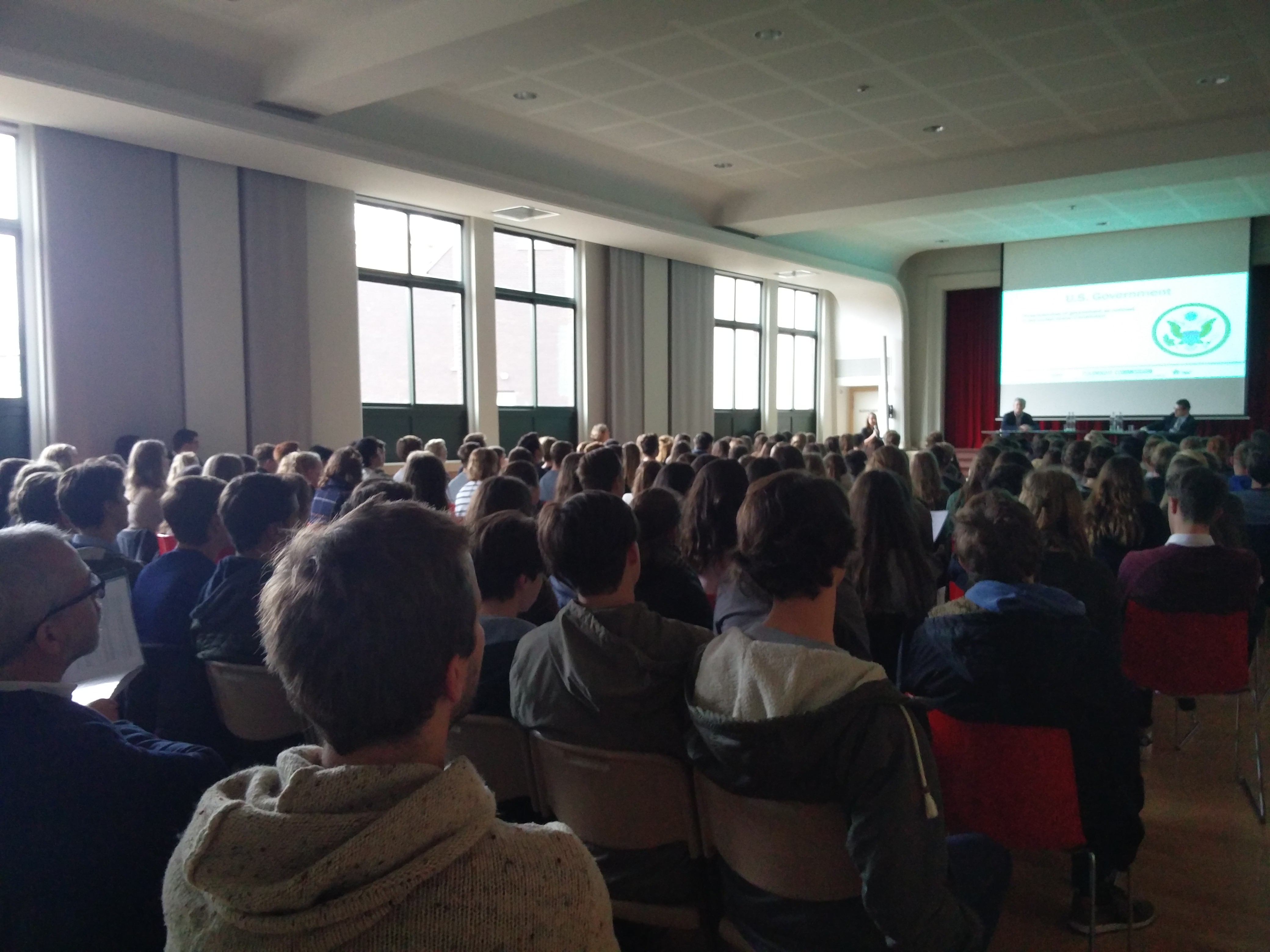
The audience brought together students, professors and people from industry with an interest in science and Darwin.
But there was an unusual condition attached to the toast.
Anyone willing to give a short and powerful presentation — no more than five minutes — about Darwin or one of his discoveries could participate in the intellectual part of the celebration.
It captured an idea that would become characteristic of Darwin’s Drink:
science does not always have to remain inside the lecture hall.
Sometimes a scientific conversation can begin with people simply gathering around a glass.
Professor Filip Volckaert and the first scientific toast
At the 2009 celebration, Professor Filip Volckaert of KU Leuven’s Laboratory of Animal Diversity and Systematics gave a presentation placing Darwin’s work in both historical and modern scientific context.
He recalled the young Darwin travelling aboard HMS Beagle, observing the natural world and gradually developing ideas that would fundamentally change biology.
But Volckaert also looked beyond Darwin.
Genetics, genomics, evolutionary biology and research into interactions between organisms and parasites had transformed scientists’ ability to test evolutionary hypotheses that Darwin himself could never have investigated experimentally.
His conclusion captured the spirit of the occasion:
Darwin should not merely be commemorated as a historical figure. His ideas should provide a starting point for continuing scientific inquiry.
The event subsequently led to discussion about evolution and creationism among readers and academics.
Why Darwin?
Charles Darwin was born in Shrewsbury, England, on 12 February 1809.
His voyage aboard HMS Beagle between 1831 and 1836 exposed him to an extraordinary diversity of animals, plants, fossils and geological formations.
Over the following decades, Darwin developed his theory that species change over generations and that natural selection is one of the principal mechanisms driving that change.
In 1859 he published On the Origin of Species.
The implications extended far beyond zoology.
Darwin changed the way humanity understood its relationship with the natural world.
Humans were no longer observers standing outside nature.
We were part of it.
Our own biological history had been shaped by the same evolutionary processes operating throughout life on Earth.
That makes Darwin particularly appropriate for an institute whose motto is:
Inquirere et Immutare — To Study and Reform.
Darwin studied the world around him.
What he discovered changed how the world understood itself.
From Leuven to the world
Darwin’s Drink did not remain confined to Belgium.
A particularly interesting development came in 2020, when FLI invited people around the world to participate.
One response came from perhaps the most appropriate location imaginable:
Down House in Kent, Darwin’s former home.
Darwin lived and worked there for approximately four decades, and much of his scientific thinking and writing took place in the house and surrounding gardens.
Staff and volunteers at Down House joined the initiative by raising a glass to Darwin near the veranda from which he once looked out over his garden.
Thousands of kilometres away, another celebration took place at a location inseparably connected with Darwin’s legacy.
A toast from the Galápagos
The Charles Darwin Research Station in the Galápagos Islands also responded to FLI’s international Darwin’s Drink initiative in 2020.
The Research Station reported organising Darwin Day activities including a scientific talk, a quiz and a birthday cake.
The location carried particular symbolic weight.
Darwin visited the Galápagos Islands in 1835 during the voyage of the Beagle. His observations there later contributed to the development of his thinking about how species change and diversify.
Almost two centuries later, scientists on those same islands continue studying evolution, biodiversity and conservation.
The Charles Darwin Foundation’s mission is to provide scientific knowledge supporting the conservation of the Galápagos environment and biodiversity.
Darwin’s Drink had effectively travelled from a zoological museum in Leuven to one of the landscapes most closely associated with Darwin himself.
Darwin’s Drink during the pandemic
Then evolution suddenly acquired an unexpected contemporary relevance.
The COVID-19 pandemic demonstrated on a global scale that biological evolution is not something that happened only in the distant past.
Viruses mutate.
Variants emerge.
Environmental pressures influence which variants spread successfully.
In 2021 and 2022, when normal gatherings were restricted, FLI adapted the tradition and organised the tongue-in-cheek Darwin’s Coronadrink.
The venue became:
your own house.
Participants were invited to pour whatever they had available and celebrate Darwin independently.
The humorous format concealed a serious point.
Darwin’s fundamental insight — that biological populations change under environmental pressures — remained extraordinarily relevant to understanding the modern world.
A tradition rather than an event
FLI continued Darwin’s Drink after the pandemic.
For 12 February 2024, the Institute again invited anyone who felt connected with Darwin or his ideas — or simply wanted to look into the past while thinking about the future — to participate.
The tradition continued in 2025, when FLI announced another Darwin’s Drink in Antwerp.
That continuity is important.
Darwin’s Drink is not intended to be another academic conference.
Its strength lies precisely in its simplicity.
Once a year, people are invited to stop what they are doing and consider a few enormous questions.
Where did we come from?
Why does life change?
How does scientific knowledge change our understanding of ourselves?
And which assumptions that seem obvious today might future scientists overturn?
Looking backwards to look forward
Darwin never knew about DNA.
He never saw a genome sequencer.
He could not examine mutations at molecular level or compare the complete genomes of thousands of species.
Yet the intellectual framework he helped establish made much of modern evolutionary biology possible.
That makes his story particularly relevant to the philosophy of The Future Leadership Institute.
Progress does not begin with knowing all the answers.
It begins with observation, curiosity and the willingness to question accepted explanations.
Darwin spent decades doing precisely that.
Darwin’s Drink celebrates that attitude as much as it celebrates the man.
And perhaps that explains why such a modest tradition has survived.
You don’t need a laboratory to participate.
You don’t need to be a biologist.
You don’t even need to drink alcohol.
On 12 February, you simply need a glass, a little curiosity and a few minutes to think about the extraordinary journey that connects the first forms of life on Earth with ourselves.
Then raise the glass.
To Darwin.
And to whatever science discovers next.
EDITION 12 February 2026
Venue: BELGIUM – ANTWERP: WUNDERKAMER, near Central Station Antwerp, Belgium
If you feel in anyway connected to Darwin or his ideas, or you just want to look back in the past while thinking about the future, join us 12-2-2026.
Don’t hesitate to forward this invitation to people who you know might be interested to join the drink.
Contact: info@fli.institute
About Darwin’s Drink: Darwin’s Drink is an initiative of The Future Leadership Institute (FLI) celebrating Charles Darwin’s birthday on 12 February and encouraging reflection and discussion about evolution, science and human origins. Documented FLI editions include the 2009 bicentenary celebration at KU Leuven, international participation from Down House and the Galápagos Research Station in 2020, the pandemic-era Darwin’s Coronadrink, and subsequent annual celebrations.
Categories: Darwin's Drink, Events


