






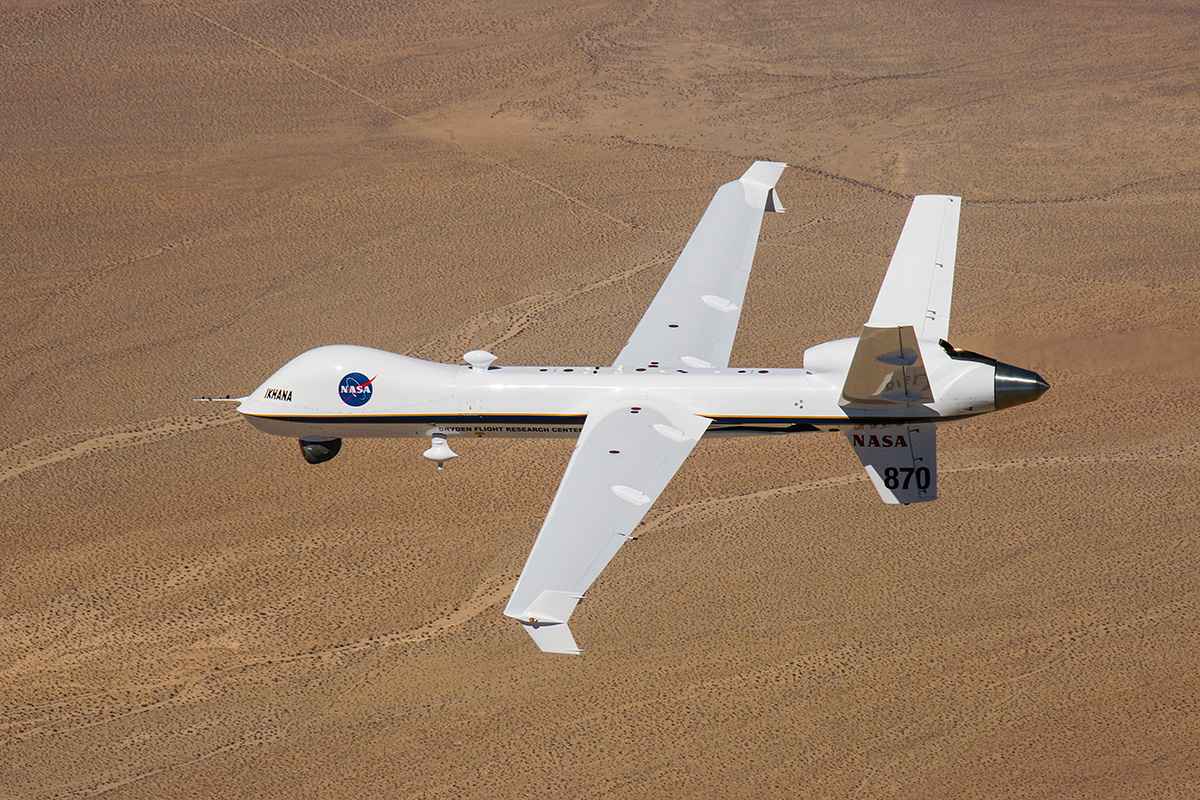
NASA’s Ikhana Drone (NASA / GA-SAI Photo)
The Predator drone is an iconic symbol of America’s current wars, and it’s younger — but bigger — Predator-B sibling often goes by the ominous name Reaper. In NASA’s hands, the Predator-B is instead Ikhana, from a “Native American Choctaw word meaning intelligent, conscious or aware,” and today the Ikhana flew to see not insurgents moving across distant sands, but the Orion capsule crashing into the sea.
Ikhana is a good watcher of the waves, thanks to it’s more than 3,000 pounds of sensors — including radar and imagery equipment. While the specific task may be different than that of the U.S. Air Force’s Reapers, flying a long time while watching a monotonous landscape, or in this case seascape, is exactly the kind of task the Predator-B was made for.
After the Orion launch, the public got to see the payoff first hand. The Ikhana’s infrared cameras detected the capsule, and then optical cameras streamed the video to watchers at NASA and online. Thanks to spotting by the drone, U.S. Navy vessels on the surface moved in to recover the capsule. Here’s the drone-filmed splashdown of the capsule into the Pacific Ocean:
The Ikhana is just one part of NASA’s many programs that utilize drones. In 2010, NASA used a large Global Hawk in conjunction with other aircraft to study weather patterns and hurricane formation. In 2013, NASA flew hand-launched military drones into an active volcano to study the effects of volcano-specific smog. And, NASA’s also tested a quiet, fuel-efficient flying wing and a tilt-wing vertical takeoff drone named Greased Lightning.
NASA helped fund the development of the Predator-B in hopes that it could be used for research. According to the space agency, Ikhana has a wingspan of 66 feet and measures 36 feet in length. And it’s equipped with ADS-B, a next-generation aircraft tracking technology.
NASA dispatched Ikhana this week to watch as the Orion spacecraft descended from orbit. Everything in the mission proceeded smoothly — including the drone footage stream. Ikhana offers a taste of what’s possible with unmanned aircraft in the commercial sector, although with the Federal Aviation Administration still dragging its feet on crucial regulations; drone industry officials aren’t optimistic about being able to fly their own missions anytime soon.
Source: The Washington Post, Brian Fung / Popular Science (http://www.popsci.com/), Kelsey D. Atherton,
Categories: Leadership in Space


 The Future Leadership Institute