




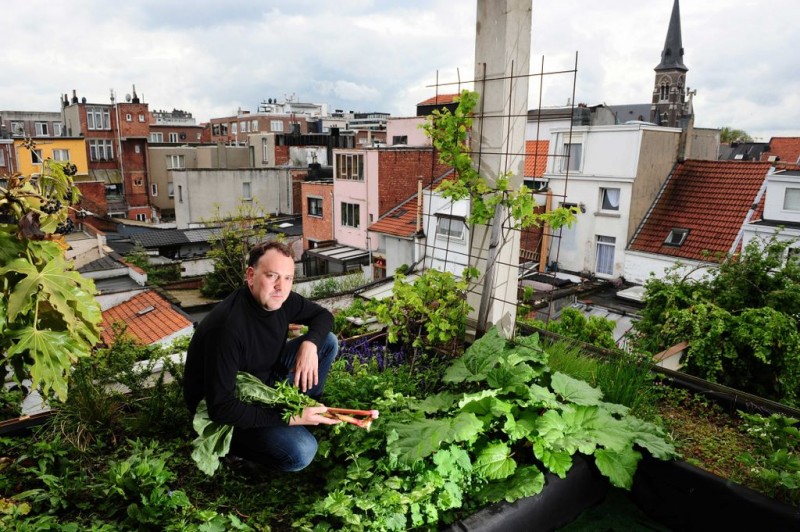
Green innovator Teun Depreeuw on one of his roof gardens in the city of Antwerp, Belgium
Researcher: Teun Depreeuw
About Teun Depreeuw: Teun Depreeuw is a green innovator living and working in Belgium. His company EcoVerbo was one of the first Antwerp building and construction companies focusing solely on eco solutions in urban architecture. Teun created “Muurtuin.be” a one stop hub specialising in designing, building and maintaining green walls. He also started to incorporate natural shells in his designs, making him the largest importer of shells in Belgium at the moment. In order to convince architects to start incorporating vertical green in their projects he turned to science to research the pro’s and con’s of implementing green walls or vertical gardens in urban environments. “It is important to be able to measure exactly what the consequences are for the environment when a building in a city starts to be covered with a green garden”, he says.
Contact Teun Depreeuw: info(at)muurtuin.be

Muurtuin.be
About the research project: In times of climate change and a shortage of resources, environmentally-responsible construction, sustainability and energy efficiency are becoming increasingly important. Cities all over the world have an urgent need for improved air quality.
Vertical green is set to deliver a healthy outcome through a system designed to “optimize, recuperate and produce energy” by capturing carbon dioxide and dust while naturally heating and cooling houses and buildings. Under sun exposure, a bare wall will contribute to heat conduction inside the building, making the internal building temperature rise, and contributing to the urban ‘heat island’ effect. But green walls, where the leaves of plants lose water through evapotranspiration, lower the surrounding air and building temperatures. Green walls also depress the cities temperature–they create a microclimate. The Tokyo Institute of Technology proved that green walls lower the energy loss of buildings. They also prevent the creation of urban dust (partly due to the effect of wind over buildings) and absorb heavy metal particulates from the atmosphere.
A green wall or a vertical garden is a wall partially or completely covered with vegetation that includes a growing medium, such as soil. Most green walls also feature an integrated water delivery system. Green walls are also known as living walls, BIOboards, biowalls, ecowalls, vertical gardens or vertical green.
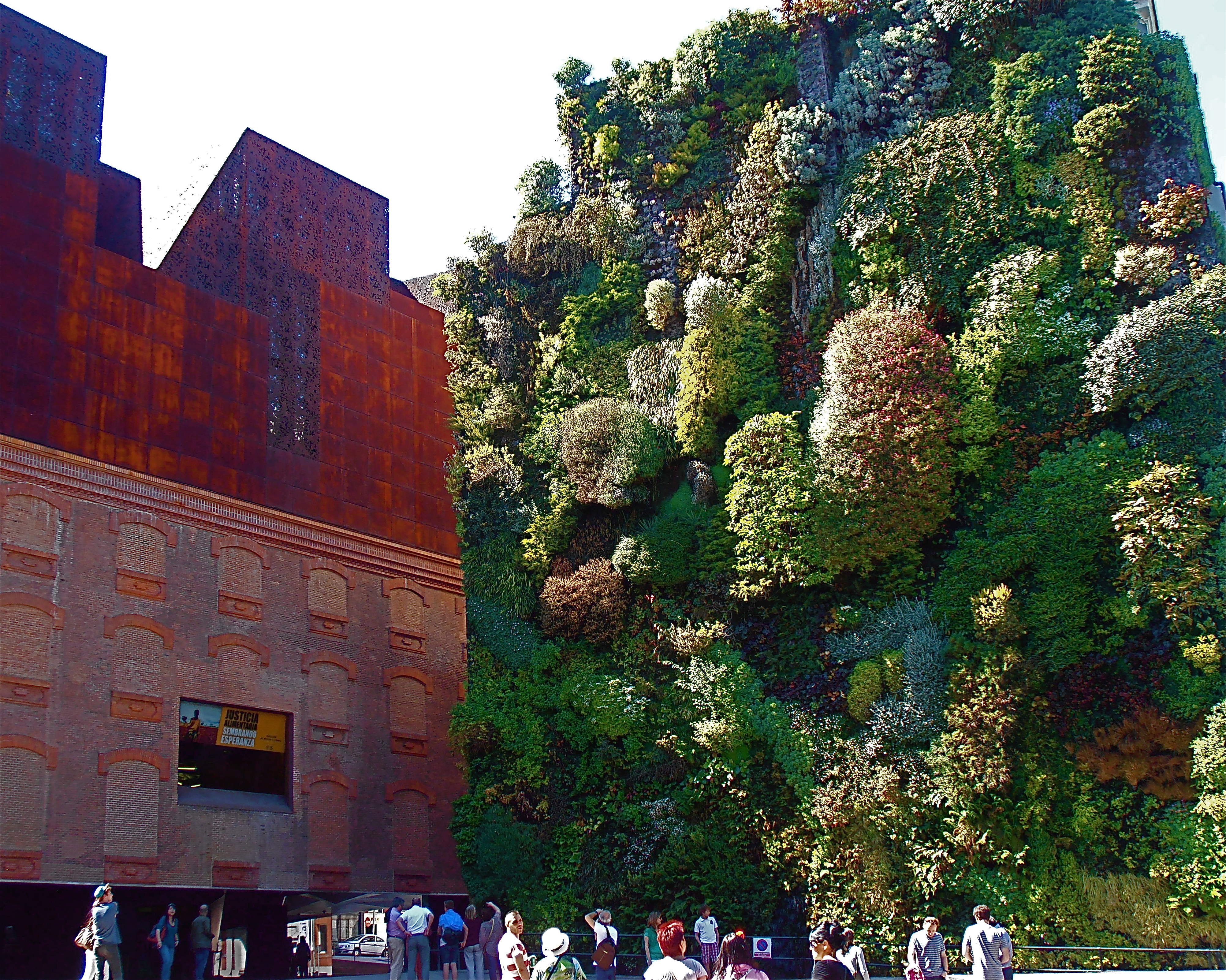 The History of Green Walls: As cities and buildings all around the world are being covered in green, we take a look at the phenomenon of green walls. The first example of green walls may be found in the Hanging Gardens of Babylon, even if they may have been more roof gardens than green walls. Later, from Scandinavia to Japan, numerous civilizations used climbing plants to cover buildings, making what is now called ‘green façades’.
Green façades were very important in the Art and Crafts and Modern style movements in Europe. For instance, in the beginning of the 20th century, the ‘Jugendstil’ movement used climbing plants (Parthenocissus tricuspidata) on the buildings to make a seamless changeover between the house and garden. In England, the Garden City movement showed great examples of green façades. William Robinson and Gertrude Jekyll designed outdoor vegetated rock walls used for screening & boundaries in gardens. You can still see such examples in Griftpark (Ultrecht, Netherlands). The use of climbing plants declined in the 30′s, due to new building techniques and people’s concern about possible consequences on wall stability. Patrick Blanc, a French botanist, is noted as the first to design the ‘modern’ pattern of green walls, with a full hydroponic system, an inert medium and numerous exotic species. His first green wall is at the Museum of Science and Industry. In Canada, where winters are very long, green walls are placed inside buildings to help offset SAD (Seasonal Affective Disorder).
Green façades have always been less common in North America. Nowadays, what we call ‘vertical gardens’ seems to have first been theorized in the U.S. in 1937 by Stanley Hart White which pre- dates Patrick Blanc’s work in France. His theories are now being used once again by students at University of Illinois at Urbana-Champaign. ( by Marie-Laure Séguin, http://landarchs.com/vertical/)
Categories: Research


 The Future Leadership Institute